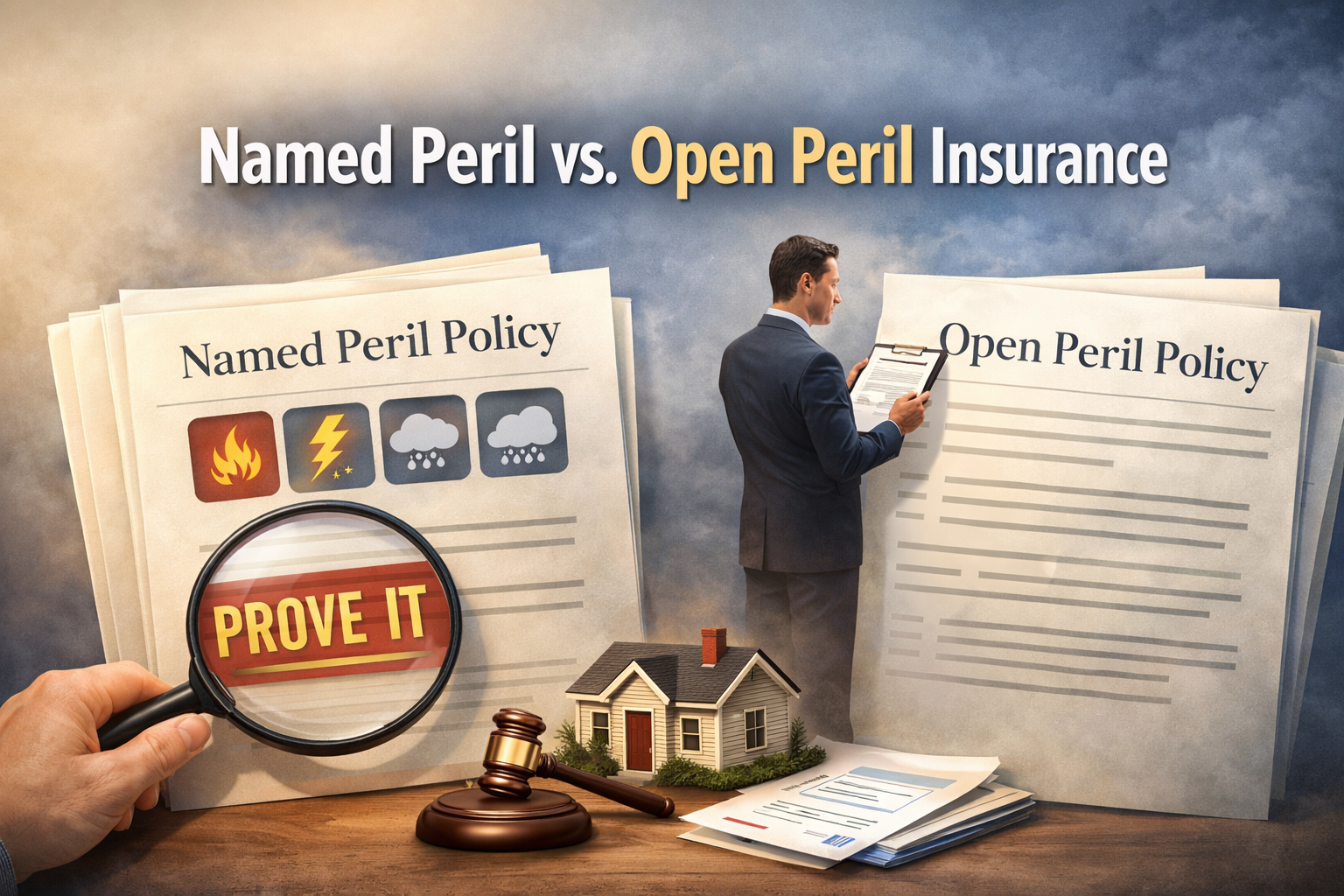
When you file a homeowners insurance claim, one of the most important factors affecting
whether your claim gets paid is something most policyholders never think about:
Is your policy written on an open peril basis or a named peril basis?
This distinction can determine who has the burden of proof—and ultimately, whether your claim
gets approved or denied.
If you don’t understand how this works, you could end up leaving thousands of dollars on the
table.
What Is a Named Peril Policy?
A named peril policy only covers losses caused by risks that are specifically listed in your
policy.
Common named perils include:
– Fire
– Lightning
– Windstorm
– Hail
– Theft
– Vandalism
– Explosion
If the cause of your damage is not explicitly listed, your claim may be denied.
Why This Matters
With a named peril policy:
The burden of proof is on YOU, the homeowner.
That means you must:
– Identify the exact cause of loss
– Prove that the cause is listed in your policy
– Provide documentation supporting your claim
– If you cannot clearly connect your damage to a named peril, the insurance company has a strong basis to deny the claim.
What Is an Open Peril Policy?
An open peril policy (also called “all-risk” coverage) works in the opposite way.
Instead of listing what is covered, it covers everything except what is specifically excluded.
This is the coverage structure used in the broad form HO3 homeowners insurance policy for the dwelling.
Why This Is Important
With an open peril policy:
– The burden of proof shifts to the insurance carrier.
– If you file a claim, the insurance company generally must:
– Investigate the loss
– Identify a specific exclusion
– Provide evidence that the exclusion applies
– Cite the exact policy language supporting the denial
If they cannot do this, the claim typically should be covered.
The Key Difference: Who Has the Burden of Proof?
This is where most homeowners get caught off guard.
Named Peril Policy
– You must prove your loss is covered
– You must connect the damage to a listed peril
Lack of evidence can result in denial
Open Peril Policy (Most Dwellings on HO3 Policy in Texas)
– The claim is presumed covered when filed
– The carrier must prove it is excluded
– The carrier must provide evidence and policy support
Why Open Peril Coverage Is Typically Better
Open peril policies generally offer broader protection, which is why they are often:
– More expensive
More comprehensive
– More favorable for homeowners during claims
Instead of trying to “fit” your loss into a narrow category, coverage is assumed unless the insurer can prove otherwise.
Where Homeowners Run Into Problems
Even with an open peril policy, many claims are still denied.
Why?
Because some insurance companies may attempt to:
– Misapply exclusions
– Shift the burden of proof back onto the homeowner
– Argue wear and tear instead of sudden damage
– Use vague or unsupported conclusions
Without proper documentation and policy interpretation, homeowners may not realize:
It is the carrier’s responsibility to prove why your claim is NOT covered under Texas open peril policies. It is not the other way around.
What You Should Do Before Filing a Claim
To protect yourself, it’s important to:
– Review your policy to confirm if you have open or named peril coverage
– Document all damage thoroughly
– Identify the cause of loss to your insurance as clearly as possible
– Preserve evidence (photos, reports, timelines)
Understanding your policy structure can dramatically impact the outcome of your claim.
How SAPIA Public Adjusters Helps
At SAPIA Public Adjusters, we help property owners navigate complex insurance policy language and claim disputes.
We:
– Analyze your policy to determine coverage type
– Identify whether the burden of proof is being applied correctly
– Challenge improper denials or exclusions
– Handle the claim process on your behalf
Our goal is simple:
Make sure the insurance company honors the coverage you paid for.
Get a Free Claim Review
If your claim has been delayed, underpaid, or denied, you may not be getting the full benefit of your policy.
Contact SAPIA Public Adjusters today for a free consultation.
We’ll review your policy, explain your rights, and help you determine the best path forward.
Email us at claims@sapublicadjuster.com or call us 24/7 at 210-988-6118
Leave a Reply